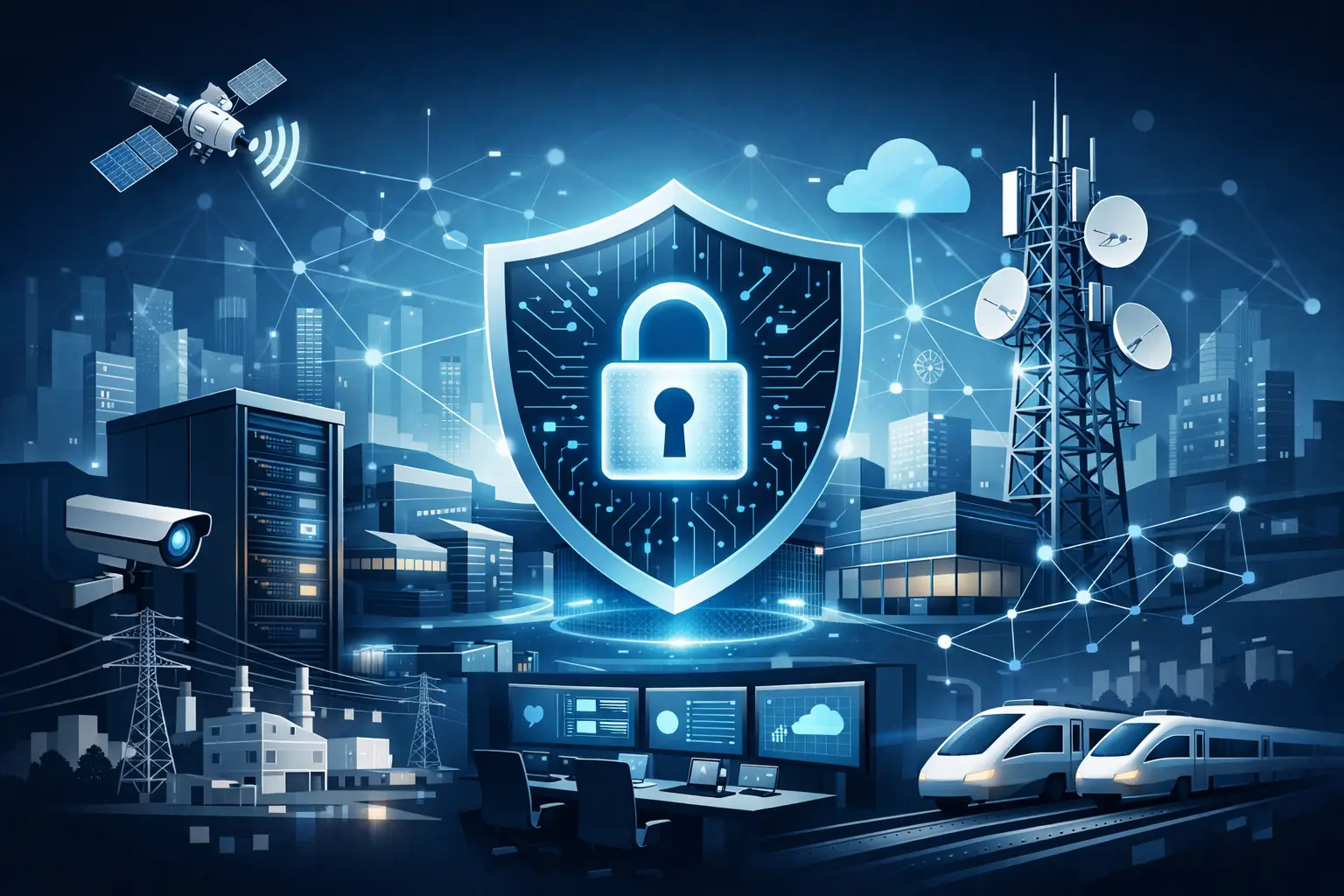
Cybersecurity for digital infrastructure and its importance for business continuity
When a platform fails, a control system malfunctions, or sensitive data is compromised, the loss is not merely technical.Energy sectorsIn logistics, real estate, manufacturing, and digital services, cybersecurity for digital infrastructure becomes a matter of business continuity, corporate trust, and the ability to meet operational and organizational obligations simultaneously.
Digital infrastructure is no longer limited to servers and databases. It's an interconnected network encompassing data centers, cloud applications, identity and access systems, user devices, industrial networks, analytics platforms, and the interfaces that connect partners, suppliers, and customers. The greater this interconnection, the wider the attack surface, and the higher the cost of any lapse in visibility, governance, or response.
Why has cybersecurity for digital infrastructure become a board priority?
Digital transformation has expanded growth opportunities, but it has also shifted risks from a limited, technical sphere to a comprehensive, enterprise-wide one. Today, a cyberattack can disrupt a supply chain, delay a construction project, cripple financial operations, or damage the reputation of an organization built on years of trust. For this reason, cybersecurity is no longer an operational matter left entirely to IT teams; it has become a matter of leadership, investment, and enterprise-wide risk management.
Executive leadership views cybersecurity from two interconnected perspectives. The first is defensive, focusing on protecting assets, operations, and compliance. The second is strategic, enabling the organization to confidently expand digitally, forge more complex partnerships, and build data-driven and constantly connected business models. An organization with mature controls is not only less vulnerable to losses but also more agile and capable of growth.
What makes digital infrastructure more vulnerable to risks?
The problem is not always a technically sophisticated attack. In many cases, the flaw starts with an account with broad privileges, an outdated system that is no longer supported, an external resource connected to the network without sufficient controls, or operational teams working in overlapping environments without a clear classification of assets and data.
Rapid expansion also creates an additional challenge. Organizations that grow across multiple sectors or geographic locations tend to accumulate disparate systems. This accumulation dilutes central vision and makes policy unification more complex. Herein lies the well-known paradox of cybersecurity: the more digital and agile an organization becomes, the greater the discipline it needs in governance, engineering, and control.
There is also a crucial difference between protecting traditional IT infrastructure and protecting operational or industrial environments. Office systems can be updated relatively quickly, while systems related to production, facilities, or control may require carefully calculated downtime, necessitating a balance between security and continuity. Therefore, there is no one-size-fits-all approach. What works for a banking or consulting environment may not be suitable for an industrial facility or a logistics network.
Cybersecurity for digital infrastructure starts with governance.
Investing in tools alone is not enough. Many organizations have advanced security platforms, but they lack a clear decision-making model: who sets priorities, who accepts risks, who reviews compliance, and who coordinates security, operations, legal, and supplier management. Without this clarity, technology becomes fragmented and fails to produce a cohesive defense.
Effective governance begins with identifying and classifying critical assets based on the impact of their failure or breach. The organization then links assets to risks, controls, and responsibilities. This step may seem administrative, but it is fundamental to security maturity. What we don't know precisely cannot be protected, and responses cannot be prioritized if critical assets are not defined at the business level.
Then come identity and access policies. In most impactful incidents, the question isn't just how the attacker gained entry, but how they moved within the environment after gaining access. Reducing privileges, separating administrative accounts, conducting periodic access reviews, and documenting communications with third parties are all practices that significantly reduce risk. They may not be flashy measures, but they are often more effective than unchecked spending on new tools.
From perimeter defense to a zero-trust model
For a long time, security strategies were built on the idea of a trusted internal network and fortified external boundaries. This assumption is no longer viable with the rise of distributed work, cloud services, integration with vendors and partners, and the proliferation of devices and access points. Therefore, advanced organizations have shifted to a zero-trust model, which doesn't mean absolute distrust, but rather continuous verification and not granting access based solely on network location.
Implementing this model requires a gradual maturation process. It's unrealistic for a large organization to transition to zero trust all at once. A better approach is to start with sensitive identities, the most influential systems, and remote access pathways, then expand controls based on risk. This approach is more balanced than radical transformation projects that appear ambitious on paper but falter in implementation.
Continuous vision is more important than sporadic spending.
Many organizations focus on purchasing security solutions, only to later discover that the fundamental problem was a lack of visibility. What assets are currently connected? What systems are outdated? What accounts are unused? What data is moving between environments? And what are the indicators of abnormal behavior?
Continuous security visibility empowers management to make decisions based on reality, not assumptions. It is also essential for rapid response. When a cyber incident occurs, every minute counts. An organization with unified records, effective monitoring, and the ability to correlate indicators can significantly reduce the time required for detection, analysis, and containment.
However, monitoring tools should be handled with care. Too many alerts without careful tuning can create operational overload and may obscure critical warnings among thousands of low-value notifications. Therefore, the quality of the tuning and analysis is just as important as the volume of data collected.
Digital supply chains are a common weakness
Modern organizations rely on a vast network of suppliers, service providers, and technology contractors. This reliance offers flexibility and speed, but it also introduces a layer of risk that cannot be managed solely through procurement contracts. Third parties may have direct access to sensitive systems, handle critical data, or, in turn, depend on less experienced third parties.
Therefore, supplier risk management should be an integral part of the cybersecurity program, not a separate activity. Pre-assessment, minimum control requirements, periodic review mechanisms, and termination plans upon contractual termination are all essential elements. In highly sensitive environments, it makes sense to design supplier integrations with limited access and the ability to be revoked when necessary.
Incident response is not a plan on paper.
Having a response policy doesn't guarantee actual preparedness. Testing reveals gaps: Do you know who makes the decision when a critical service goes down? Are the escalation channels clear? Is there coordination between technology, corporate communications, and operations? And have scenarios such as ransomware attacks, data breaches, service outages, and backup failures been considered?
An effective response rests on three levels. The first is technical, encompassing detection, containment, analysis, and recovery. The second is operational, focusing on business continuity and minimizing the impact on customers and partners. The third is leadership-related, pertaining to decision-making, governance, and disciplined communication. Any weakness at any of these levels disrupts the entire strategy, even if technical capabilities are strong.
It is important to note here that backups alone are not a guarantee. The value of backups only becomes apparent if they are isolated, tested, and recoverable within the required operational timeframe. Many organizations discover during a crisis that theoretical recovery differs from actual recovery.
Building a security culture without disrupting business
The weakest point in many environments isn't just the end user, but also the gap between security and business teams. When employees view security as a hindrance, they tend to circumvent controls. And when the security team speaks in purely technical terms, it loses its ability to influence decision-making.
A successful security culture is not based on intimidation, but on transparency and shared responsibility. The operations manager must understand the impact of shutdowns, employees must be aware of the risks of social engineering, suppliers must adhere to accessibility standards, and senior management must know the metrics that reflect true maturity. This type of culture requires ongoing training, but it also requires leadership that treats security as an integral part of operational quality, not as an isolated function.
In this context, the role of institutions that combineOperational expansionAnd institutional discipline. When multi-sector groups treat cybersecurity as an enabler of growth and sustainability, they raise the level of preparedness across their operations, a perspective that aligns with the Kingdom’s economic and technological transformation trends.
What distinguishes a cyber-mature organization?
A mature organization isn't one that prevents every incident; that's an unrealistic criterion. Maturity is demonstrated by the ability to prioritize, minimize breaches, detect early warning signs, contain damage quickly, and learn from incidents to improve controls. It's also reflected in balanced investment decisions: avoiding overspending on underutilized assets and not postponing essential requirements under the pretext of cost.
Likewise, a mature organization understands that cybersecurity is an ongoing management journey, not a finished project. Threats change, systems expand, and digital relationships become more complex. Therefore, regular reviews, practical testing, policy updates, and team readiness enhancements are all elements that must be implemented at a consistent pace that aligns with the nature of the business and its risks.
The real challenge isn't just building a higher wall, but rather building a more conscious, disciplined, and resilient organization capable of withstanding pressure. When cybersecurity for digital infrastructure is managed with this mindset, it becomes part of the organization's core value—not just a defensive function in the background.