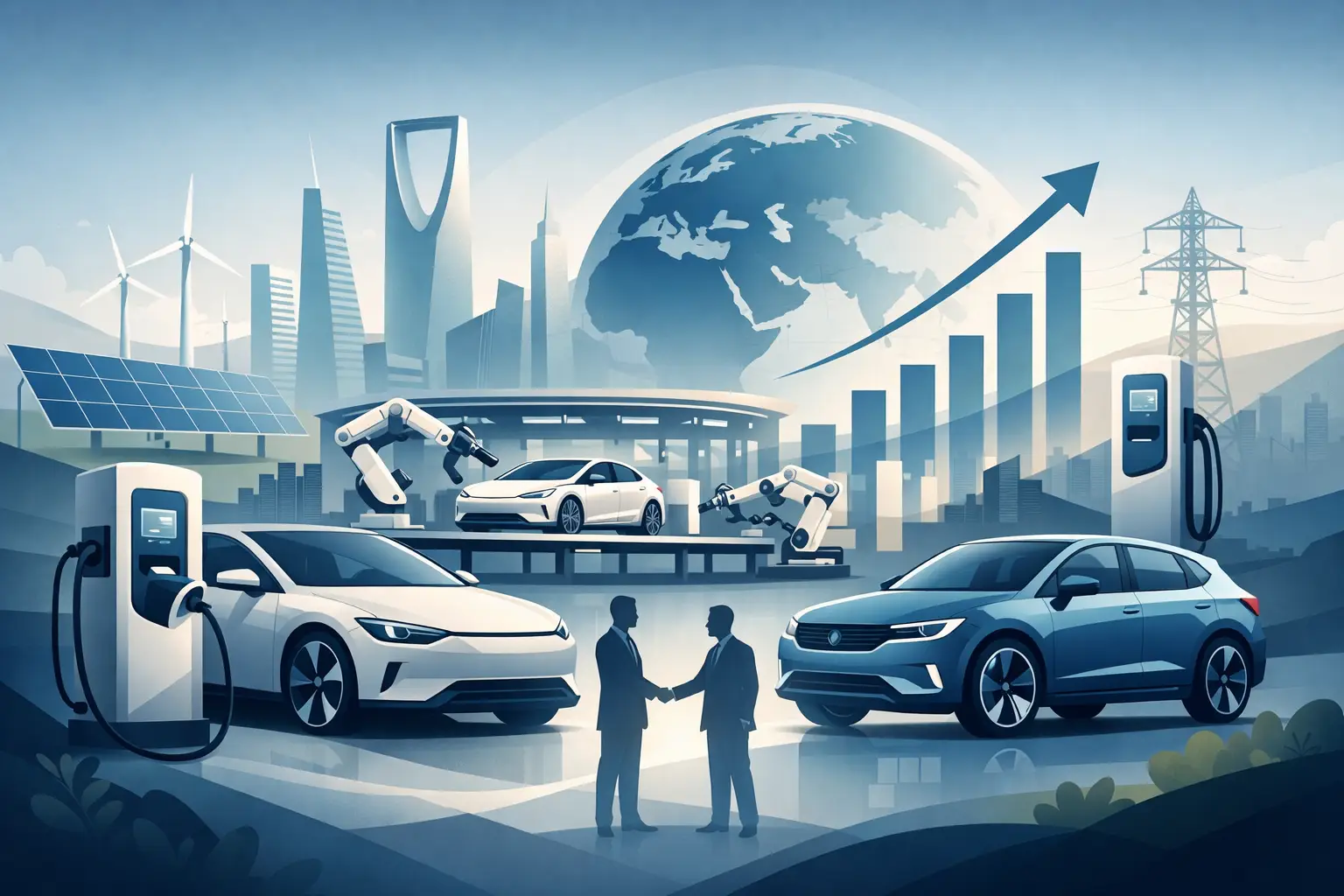
Electric car manufacturers and the future of global competition
When the value of industrial transformation is measured by its ability to reshape energy, transportation, and supply chains, electric vehicle manufacturers become more than just producers of new vehicles. We are witnessing a sector that redefines the relationship between industry, technology, infrastructure, and long-term investment, giving it particular strategic weight in markets that prioritize economic diversification and industrial sustainability.
Why have electric car manufacturers gained such importance?
The importance stems not only from the increasing demand for low-emission vehicles, but also from the vast ecosystem upon which this industry is built. An electric vehicle is not a separate product that can be evaluated in isolation from its batteries, software, semiconductors, charging infrastructure, and other components.Energy Managementand logistics. For this reason, the strength of companies in this sector is not measured only by the number of units sold, but by their ability to manage an interconnected and complex industrial system.
This also explains the different success models among companies. Some manufacturers built their dominance on technological innovation and rapid development, while others relied on large-scale manufacturing expertise, integration with robust supply chains, or the ability to enter multiple markets with organizational and operational flexibility. Therefore, there is no single formula for leadership, but rather a set of interconnected factors that determine each company's competitive position.
How are electric car manufacturers actually valued?
In public discourse, the evaluation is often reduced to brand recognition or vehicle design. However, from an industrial and investment perspective, the picture is much broader. The first factors considered are battery efficiency in terms of range, charging speed, operational lifespan, and cost per kilowatt-hour. These elements directly impact vehicle pricing, profit margins, and scalability.
Then comes the software. The modern electric vehicle has become as much a mobile digital platform as it is a means of transportation. Battery management systems, remote software updates, user interfaces, and smart safety features all make a real difference to the customer experience and the long-term value of the product. This is why companies that invest in in-house software capabilities often gain greater flexibility in development and continuous improvement.
The third factor is the supply chain. Stable access to critical minerals, the ability to secure essential components, and the management of geopolitical and logistical risks have all become direct determinants of production capacity. A company with strong demand but no flexible supply chain may find itself unable to meet market demand, no matter how attractive its product is.
The difference between a traditional factory and an integrated company
Some companies treat the electric vehicle as an extension of an existing product line, giving them an advantage in industry experience, but this can slow their ability to completely redesign processes. In contrast, there are companies that were founded around the concept of the electric vehicle, allowing them to build the platform, engineering, software, and supply chain to meet the requirements of this product from the outset.
This doesn't mean the new model is always better. Traditional companies have clear advantages in large-scale manufacturing, distribution networks, after-sales service, and market trust. Newer companies may be faster at innovating, but they often face challenges related to profitability, production stability, and scaling operations. The issue here isn't absolute superiority, but rather each model's ability to adapt to the market stage in which it operates.
What distinguishes the leading companies in this sector?
The most influential companies don't succeed simply because they produce electric vehicles, but because they understand that competition revolves around the entire ecosystem. The ability to reduce costs without compromising quality is essential, but what's even more important is transforming those reductions into a sustainable advantage, not a temporary measure. Furthermore, investing in research and development is no longer a supplementary option; it has become a prerequisite for maintaining a presence in a rapidly evolving market.
Decisions regarding manufacturing distribution are also crucial. Relying on a single facility or geographic region increases risk, particularly in industries affected by trade policies, transportation costs, and raw material availability. Therefore, many companies are building regional production networks closer to their final markets, which enhances resilience and reduces vulnerability to disruptions.
Here, another equally important dimension emerges: partnerships. A growing number of manufacturers are no longer operating on a completely self-sufficient basis, but rather through alliances with battery producers, technology companies, charging solution providers, and even power suppliers. These partnerships do not necessarily indicate a lack of capability; rather, they may reflect a more mature understanding of the platform economy and risk diversification.
Challenges facing electric vehicle manufacturers
Despite the sector's evident growth, describing the industry as a straight path would be inaccurate. The primary challenge is margin pressure. Developing new platforms, building factories, securing batteries, and investing in software are all capital-intensive activities. As competition intensifies, maintaining a balance between growth and profitability becomes increasingly complex.
The second challenge relates to demand itself. The market doesn't move at the same pace in all countries. Some mature markets benefit from incentives, infrastructure, and consumer awareness, while others are still in their early stages, where vehicle prices, shipping availability, purchasing power, and customer preferences influence the speed of adoption. Therefore, a company's success in one market doesn't necessarily guarantee the same level of success in another.
The third challenge is both regulatory and technical. As the use of electric vehicles expands, regulatory expectations are rising regarding safety, battery recycling, supply chain traceability, and environmental standards. This requires companies to build advanced compliance capabilities, not just focus on manufacturing and production.
The batteries are the real center of gravity.
If there's one element that encapsulates both the challenge and the opportunity, it's the battery. It's the most expensive component in an electric vehicle, and also the most crucial factor in the user experience. The type of chemistry used, energy density, operational safety, and ease of recycling are all factors that will determine the future of almost every company.
Investing in batteries is not just about product development; it's about reshaping industrial value chains. This is why many companies are pursuing partial or full vertical integration in this area, or forging long-term partnerships with cell and raw material suppliers. In both cases, the ability to secure supply and optimize costs remains a crucial competitive advantage.
Saudi marketAnd the broader industrial opportunity
In the Kingdom, the discussion surrounding electric vehicles extends beyond consumption to include manufacturing, technology, knowledge localization, and the development of modern industrial ecosystems. This trend aligns with the priorities of economic diversification, increasing local content, and developing value-added sectors. From this perspective, the presence of electric vehicle manufacturers in the Saudi landscape is not measured solely by the number of vehicles, but also by the industrial expertise, high-quality jobs, partnership opportunities, and future export capabilities they can contribute.
The opportunity here is not automatic. Success requires suitable infrastructure, scalable supply chains, a clear regulatory environment, and long-term investments in skills, engineering, and advanced technologies. However, it is also a path of significant strategic value, as the electric vehicle sector intersects with energy, logistics, artificial intelligence, and digital transformation—all priority areas in ambitious economies.
In this context, the role ofInvestment groupsThe industrial sector views itself as part of a broader development system, not as a separate field. This integrated vision is what gives industrial projects greater capacity for sustainability and expansion, especially when linked to clear objectives in innovation, manufacturing, and building cross-sectoral partnerships.
Where are electric car manufacturers headed?
The next phase will not be decided solely by the launch of new models, but by who can manufacture more efficiently, update products more quickly, manage data and software effectively, and ensure an uninterrupted supply of batteries and raw materials. Furthermore, competition will increasingly focus on the mid-price segment, as expanding adoption requires products that better meet actual market needs, rather than relying solely on high-end or niche categories.
There is also likely to be an increased focus on vehicle-related services, such as charge management, predictive maintenance, vehicle integration with electric grids, and commercial fleet solutions. This means that a company that sees itself solely as a car manufacturer may find its scope limited compared to one that treats the electric vehicle as a comprehensive business platform.
Ultimately, this sector doesn't reward speed or size alone. What distinguishes players capable of enduring is the combination of industrial discipline, technological innovation, operational flexibility, and a long-term vision. Anyone observing market developments strategically will find that the question is no longer who will enter this field, but who will build genuine value that can withstand the test of time.