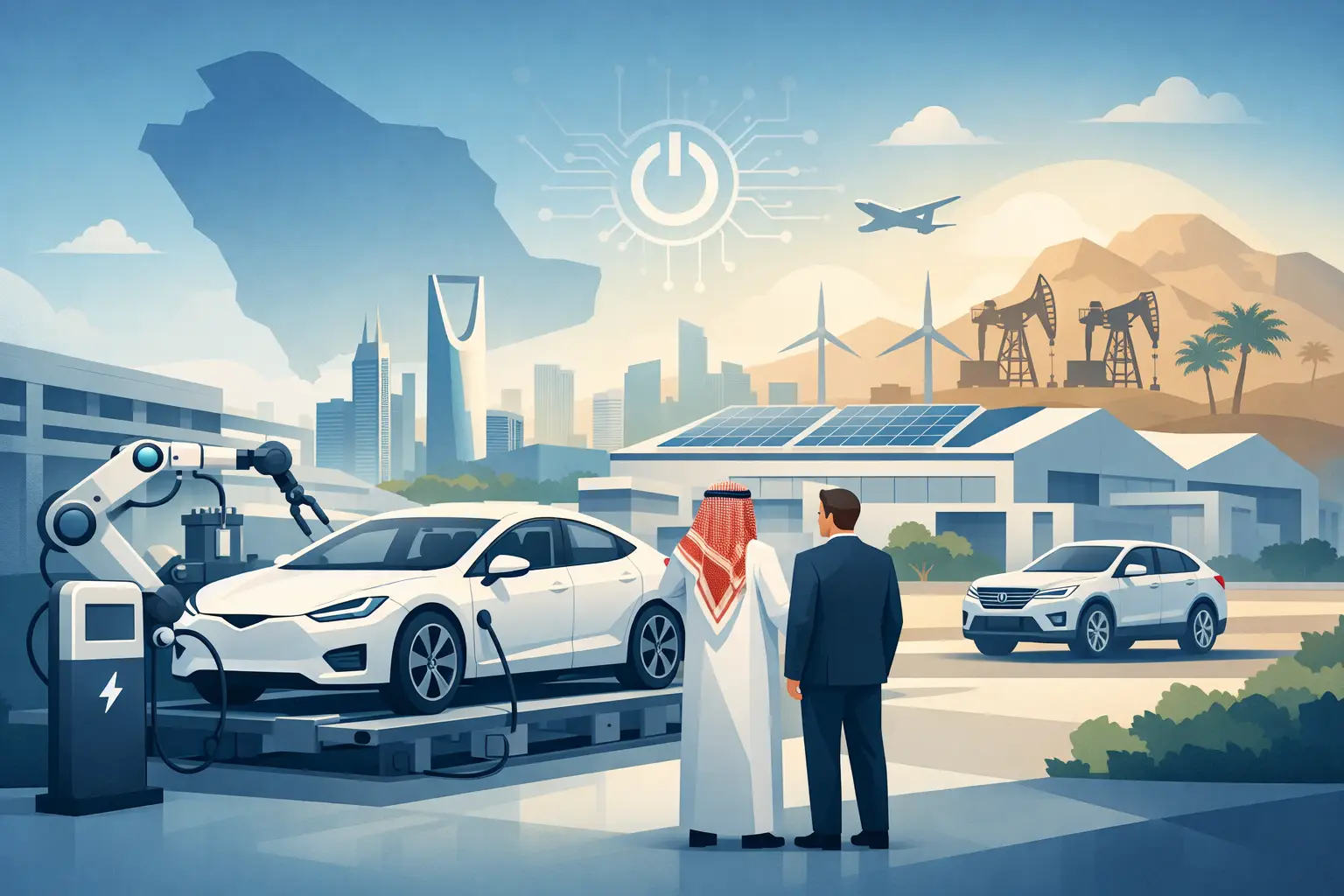
Electric vehicle manufacturing in Saudi Arabia and its role in industrial development
When a country the size of the Kingdom transforms from a major consumer market into an advanced industrial base, the mobility sector becomes a true test of its capacity to execute. Therefore, manufacturing electric vehicles in Saudi Arabia takes on importance that extends beyond simply producing the cars themselves, as it is linked to advanced manufacturing, technology localization, increasing local added value, and building an industrial system capable of competing regionally and internationally.
Talking about this sector should not be reduced to the question: Will the Kingdom produce electric cars? The more accurate question is: What kind of system is being built around this industry, and how capable is it of continuing and expanding? Here the broader picture appears, as it is not just about assembly lines, but about a long chain that begins with industrial policies and incentives, and extends to infrastructure, skills, logistics, standards, and research and development.
Why does manufacturing electric vehicles in Saudi Arabia represent a strategic opportunity?
The Kingdom possesses several advantages that make this sector a logical investment and industrial choice. The first of these is its economic size, the second is its strategic geographic location connecting Asia, Europe, and Africa, and the third is its clear national focus on economic diversification within the framework of Vision 2030. When these elements are combined with a growing infrastructure and strong logistical capabilities, the industry becomes more than just a limited sectoral project.
Another advantage is that electric vehicles occupy an intersection between several priority sectors.touching the energyManufacturing, software, logistics, shipping infrastructure, data management, and sustainability. This means that every investment in this area can generate a multiplier effect in other sectors, making the economic return not limited to the sale of the final vehicle.
From a public policy perspective, this industry serves clear objectives related to localizing supply chains, creating quality jobs, attracting technology partnerships, and increasing the industrial sector's contribution to GDP. However, success here is not measured solely by announcing a factory or signing an agreement, but rather by the system's ability to gradually transition from assembly to advanced manufacturing.
What does Saudi Arabia need for this industry to succeed?
The success of electric vehicle manufacturing in Saudi Arabia depends on the integration of five key pathways. The first pathway is manufacturing itself, encompassing chassis, electrical systems, internal components, and operating software. The second pathway is batteries, including assembly, thermal management, and recycling. The third pathway is charging infrastructure. The fourth relates to human resources and skills, and the fifth to institutional and commercial market demand.
Industry doesn't start with the highest localization rate from day one. That's unrealistic in any emerging market. The natural path often begins with assembly, then localizing selected components, then developing first- and second-tier suppliers, and finally introducing greater engineering capabilities. The challenge here is that each stage requires sufficient demand, regulatory stability, and long-term investment.
Building a local supplier base is no easy task. Many of the precision components in electric vehicles require high quality standards and rigorous certifications. Therefore, attracting global companies alone is not enough; local companies must be enabled to enter the industrial chain through knowledge transfer, training programs, and long-term contracts.
Supply chains are the decisive factor
In the electric vehicle industry, supply chains are not an operational detail but rather the foundation of viability. A delay in a single component can impact an entire production line. Therefore, the Kingdom has a significant opportunity to leverage its strategic location, ports, industrial zones, and connections to regional markets. The shorter and more reliable the supply chain, the greater the ability to control costs and improve delivery times.
But there is another, more complex aspect: securing highly sensitive materials and components such as battery cells, power management systems, semiconductors, and sensors. These areas are subject to global volatility and intense competition, meaning the Kingdom’s strategy must combine international partnerships, diversified supply sources, and the gradual development of local capabilities in economically viable sectors.
Shipping infrastructure is not an extension of the sector.
Any serious discussion about electric vehicles is incomplete without adequate charging infrastructure. Business and individual consumers will not make the switch if concerns about charging persist. Therefore, the widespread availability of charging stations, and their integration with cities, major roads, shopping centers, and fleets, is essential for demand growth.
Herein lies a crucial distinction between building a market for individual consumers and one for businesses. In the early stages, fleet adoption may prove more efficient than relying solely on individual consumers, as large corporations can centrally manage shipping, accurately measure operational savings, and accelerate the adoption cycle. This doesn't eliminate the consumer market, but rather reflects a pragmatic prioritization.
Human capital is the turning point
Advanced manufacturing cannot be separated from skills. An electric vehicle is not merely an advanced mechanical product, but a platform that integrates electrical engineering, software, operational intelligence, and data analytics. Therefore, building a skilled national workforce in this field is not a secondary option, but a prerequisite for creating genuine local value.
The need isn't limited to engineers. There's a need for technicians, quality specialists, supply chain experts, industrial safety professionals, software developers, and operations managers. And the higher the level of practical training and the stronger the link between educational institutions and industry, the more sustainable the industry will be.
For this reason, programs that integrate technical education with actual industry needs may be more effective than broad, general initiatives. The sector needs specific skills, not just broad, specialized titles.
Where do the real challenges lie?
Optimism in this sector is justified, but a professional assessment requires acknowledging the challenges. The first of these is the high capital cost, both in establishing factories and developing testing and quality control capabilities. The second is the rapid pace of technological development, making investment decisions time-sensitive. The third is fierce global competition, particularly from companies with extensive production experience and large scale that allows them to reduce costs.
There is also the challenge of market size in the short term. Successful manufacturing requires a balance between domestic demand and export opportunities. If reliance is placed solely on the domestic market initially, unit costs may become high. However, if production capacity is built with a clear export vision, industrial viability becomes more robust. This requires alignment of specifications, certifications, logistics, and supply agreements.
Another significant challenge is the issue of batteries after their operational lifespan. Managing reuse or recycling will, over time, transform from an environmental concern into an industrial and commercial one in its own right. Those who start early in this area will have a future competitive advantage.
What is the expected role of the private sector?
The private sector is not merely an implementer, but a partner in shaping the ecosystem. Its role begins with direct investment in manufacturing and extends to support services such as logistics, digital systems, shipping, maintenance, and fleet solutions. Furthermore, companies capable of bridging the gap between industry, energy, and technology have a clear advantage, as electric vehicles are inherently cross-sector products.
In this context, the role of investment and industrial groups that view the market with a long-term perspective, rather than a short-term, opportunity-driven one, becomes crucial. These types of players can build partnerships, sustain the development cycle, and align investments with regulatory and technological requirements. Hence the importance of corporate models that combine industrial vision with executive discipline—an approach consistent with that adopted by leading Saudi entities such as the Al-Oudi Group in the industry, energy, and innovation sectors.
How might the sector develop in the coming years?
The most realistic scenario is gradual growth, not sudden leaps. We will likely see a phased expansion of local manufacturing, with localization increasing for some components before others. Enterprises and fleets are expected to drive a significant portion of early demand, while the consumer market expands in tandem with improved infrastructure and greater clarity regarding end-user operating costs.
Competition is also likely to become less about the vehicle as a separate product and more about the integrated system around it: shipping, operating finance, maintenance, data management, andDigital servicesThis opens up more space for companies that can build integrated solutions, not just supply a finished product.
The real opportunity for the Kingdom lies not merely in entering this sector, but in defining its position within it. Will it be an assembly market? A regional manufacturing and export hub? Or an integrated platform linking industry with energy, services, and digital infrastructure? The answer will be determined by the speed with which the system is built, not by the speed with which it is discussed.
What seems clear today is that manufacturingElectric vehicles in Saudi ArabiaIt is no longer an abstract future concept, but rather an industrial path linked to investment decisions, technological partnerships, and long-term planning. The more progress is based on discipline, a realistic, phased approach, and clear priorities, the greater the sector's potential to become an influential part of the modern Saudi industrial economy.