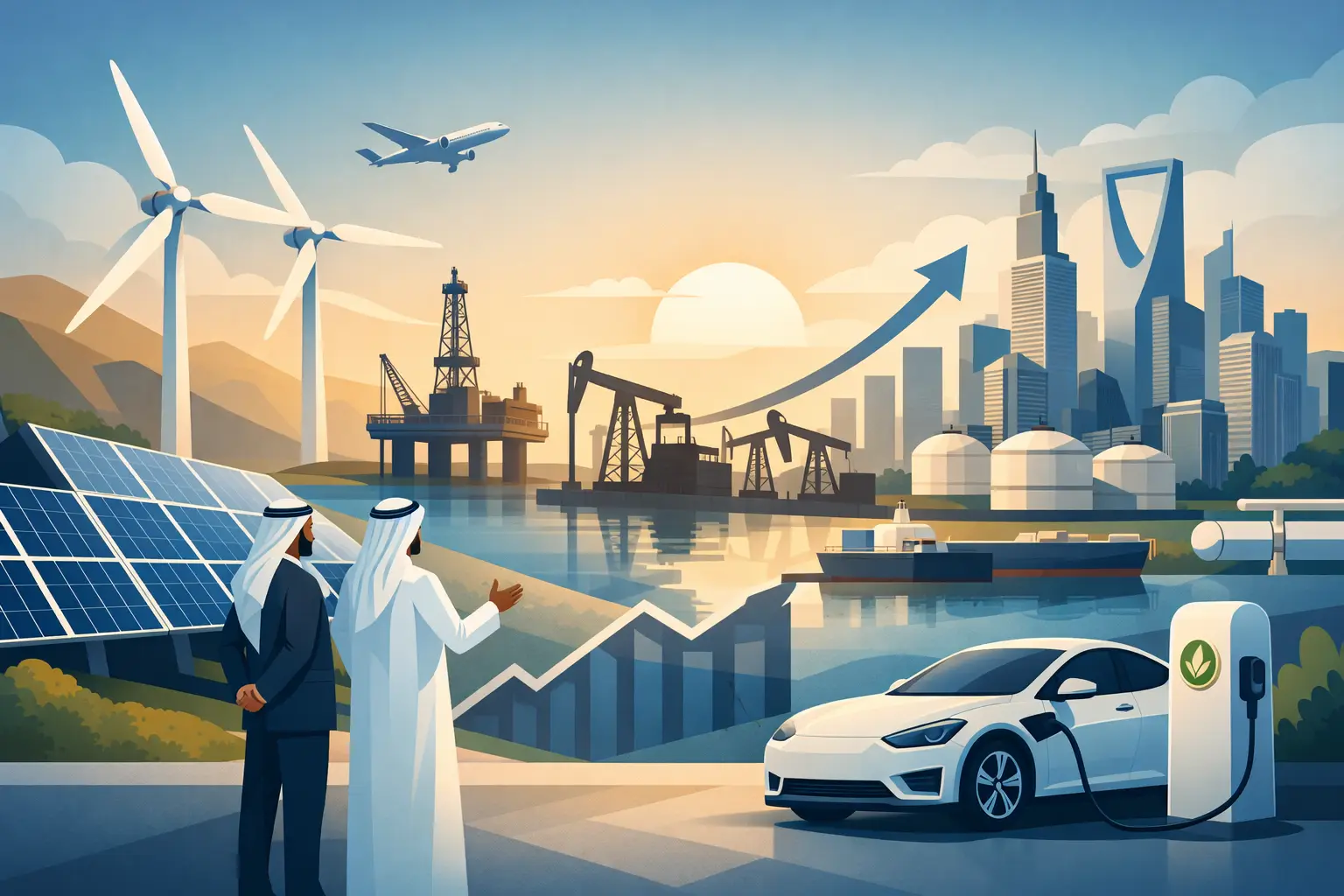
When energy prices rise or fall sharply, the impact is not limited to commodity markets alone, but extends to supply chains, manufacturing costs, government spending, and the expansion plans of major corporations. Therefore, investment in energy and oil should not be viewed as a short-term financial decision, but rather as a strategic choice linked to economic security, industrial capacity, and the shift in the energy mix at the regional and global market levels.
This sector possesses unique characteristics not found in many other fields. It combines substantial capital assets, volatile price cycles, regulatory and environmental considerations, and rapid technological advancements. Therefore, any serious approach to investing in it must go beyond the question of immediate profitability to deeper questions: Where is value created? What protects the project from market fluctuations? And how can an investment be built that remains resilient across multiple economic cycles?
Why does the energy and oil sector remain attractive to investment?
Despite the expansion of alternative energy sources, oil and gas remain a fundamental part of the global economy. Heavy industries, transportation, petrochemicals, aviation, and shipping all depend to varying degrees on this sector. This means that demand doesn't simply disappear, but rather is reshaped by factors such as population growth, industrialization, industrial policies, and changing consumption patterns.
The sector's appeal stems not only from the volume of demand but also from the breadth of its value chain. Opportunities exist in exploration and production, in support services, in storage and transportation, in refining, in distribution, and in technological solutions that enhance efficiency and reduce losses and emissions. This diversity provides investors with greater flexibility to develop different centers based on their risk tolerance, time horizon, and operational capacity.
In markets that are diversifying their economies and strengthening their industrial base, the sector is becoming increasingly important. It is not just a source of revenue, but a platform for infrastructure development, job creation, boosting local content, knowledge transfer, and supporting industries related to energy, logistics, and industrial technologies.
Investing in energy and oil: between opportunity and discipline
A common mistake is viewing the sector as simply a matter of betting on rising prices. This is a gross oversimplification. Successful investment in this area is not based solely on predicting market direction, but also on understanding asset quality, management efficiency, cost structure, and resilience in less favorable price conditions.
A project that performs well only at high price levels may seem attractive on paper, but it remains fragile. A project that can maintain its operational viability across a wider range of market conditions is more stable from an investment perspective. This highlights the difference between investing based on a temporary price cycle and investing based on solid operational and institutional foundations.
Discipline in this sector also encompasses the timing of entry, the financing structure, contracting mechanisms, and the level of exposure to geopolitical and regulatory risks. Even a sound asset can become a weak investment if it is built on inappropriate leverage, lacks clear governance, or relies on overly optimistic assumptions.
Where is value formed in the sector's value chain?
Not all opportunities in the energy and oil sectors are created equal. Upstream activities, such as exploration and production, may offer relatively high returns, but they also carry higher risks in terms of cost, price volatility, and geological viability. In contrast, midstream activities, such as transportation, storage, and infrastructure, offer greater stability in many cases, especially when linked to long-term contracts or consistent corporate demand.
Downstream activities, including refining and distribution, are affected by various factors such as operating margins, domestic consumption patterns, network efficiency, and environmental regulations. In recent years, new value categories have emerged within the sector, such as digital solutions, intelligent monitoring systems, improved operational efficiency, emissions reduction, and data-driven industrial asset management.
For this reason, it's not enough for an investor to simply decide to enter the sector in general. The key is identifying the right position within the supply chain. Some investors are better suited to exposure to infrastructure assets with more stable cash flows, while others prefer higher-risk operational opportunities with greater growth potential.
What factors determine the quality of an investment opportunity?
The first thing that deserves examination is the project's basic economics. What are the costs of production or operation? What is the break-even point? What is the level of reliance on financing? And how sensitive is it to price fluctuations or service costs? These questions reveal much that is not shown in brief presentations.
The second factor is organizational efficiency. A sector of this size and complexity cannot tolerate ad hoc management. Technical capabilities, operational discipline, asset integrity, governance, contract management, and regulatory compliance all directly impact sustainability and return. Sometimes, the organization itself is the true asset, not just the project.
Next comes the regulatory and market environment. Clear regulatory frameworks, a stable business environment, available infrastructure, and easy market access all make a significant difference. The proximity of an asset to demand centers, ports, or logistics networks can also substantially enhance its attractiveness.
The global energy transition does not eliminate oil.
One of the most misunderstood topics is the relationship between the energy transition and investment in oil and gas. The reality is more complex than the simplistic binary that assumes the rise of clean energy means an immediate decline in the role of hydrocarbons. The transition is undoubtedly underway, but it is uneven across sectors, countries, and timelines.
Some economies are progressing rapidly inelectric vehiclesRenewable energy is one sector that will transition to renewable energy, while other sectors will require more time due to infrastructure requirements, the cost of transition, or the nature of their industrial use. This means that oil and gas will remain an important part of the energy mix for the foreseeable future, but under different conditions that focus more on efficiency, reducing emissions, improving environmental performance, and increasing added value.
This is where the most promising opportunities emerge. Instead of viewing investment in energy and oil as separate from sustainability, it is more accurate to see it as a sector undergoing internal transformation. Companies that can combine operational efficiency, environmental discipline, and technological modernization will be better positioned to maintain their competitiveness and investment appeal.
The Kingdom of Saudi Arabia and the context of long-term value
In Saudi ArabiaThe sector is gaining an additional dimension linked to economic development and industrial expansion. The equation is no longer limited to traditional production, but now includes developing supply chains, manufacturing industries, support services, energy-related technologies, and developing national talent. This aligns with broader trends aimed at increasing local content and enhancing economic diversification within the framework of Vision 2030.
In this context, the strongest investment opportunity is the one that builds a lasting economic impact, not the one that merely provides a short-term financial return. Projects that are linked toInfrastructureKnowledge transfer, industrial integration, and increased efficiency are often more suited to the region's current stage of growth. Therefore, a long-term institutional perspective remains more effective than limited, speculative approaches.
Furthermore, multi-sector investment groups, such as Al Audi Group, have a comparative advantage in this type of opportunity when they view energy within a broader framework that includes logistics, technology, industrial development, and the ability to execute long-term partnerships. This type of integration creates value that transcends the boundaries of a single project.
How are risks managed in energy and oil investment?
No investment is risk-free, but the real difference lies in how risk is defined, measured, and allocated. In this sector, risk management begins with not relying on a single market assumption. The project must be tested against multiple scenarios of price, demand, financing costs, and operational time.
Diversification within the same sector may be wiser than focusing on a single activity. Furthermore, partnerships with strong operating partners, clear contracts, and disciplined maintenance and safety practices help mitigate non-financial risks, which can be as costly as, or even more so than, price risks.
It is also important to recognize that some opportunities appear attractive simply because they are large, not because they are well-managed. Size alone is not an advantage if it is not accompanied by clarity of execution, the ability to manage complexity, and a governance structure that ensures accountability and transparency. In heavy industries, operational details make a significant difference to the bottom line.
What is an institutional investor looking for today?
Institutional investors are no longer simply drawn to narratives of growing demand. They now seek a clear business model, scalability, capital discipline, management reliability, and an asset's ability to generate value in a changing environment. They are also increasingly scrutinizing efficiency indicators, compliance, and the impact of technology on cost reduction and performance improvement.
This shift raises expectations for companies operating in the sector. Simply possessing a good asset is no longer sufficient; companies must demonstrate the ability to operate it efficiently, develop it responsibly, and adapt it to market and regulatory changes. Organizations that understand this change early on are better positioned to attract quality partnerships and long-term capital.
Ultimately, the best decisions in this field are not based on market noise, but on clarity of vision, quality of execution, and discipline in evaluating opportunities. The more investment in energy and oil is part of a broader economic vision that links returns, development, and industrial capacity, the more likely it is to have a deeper impact than mere numbers.