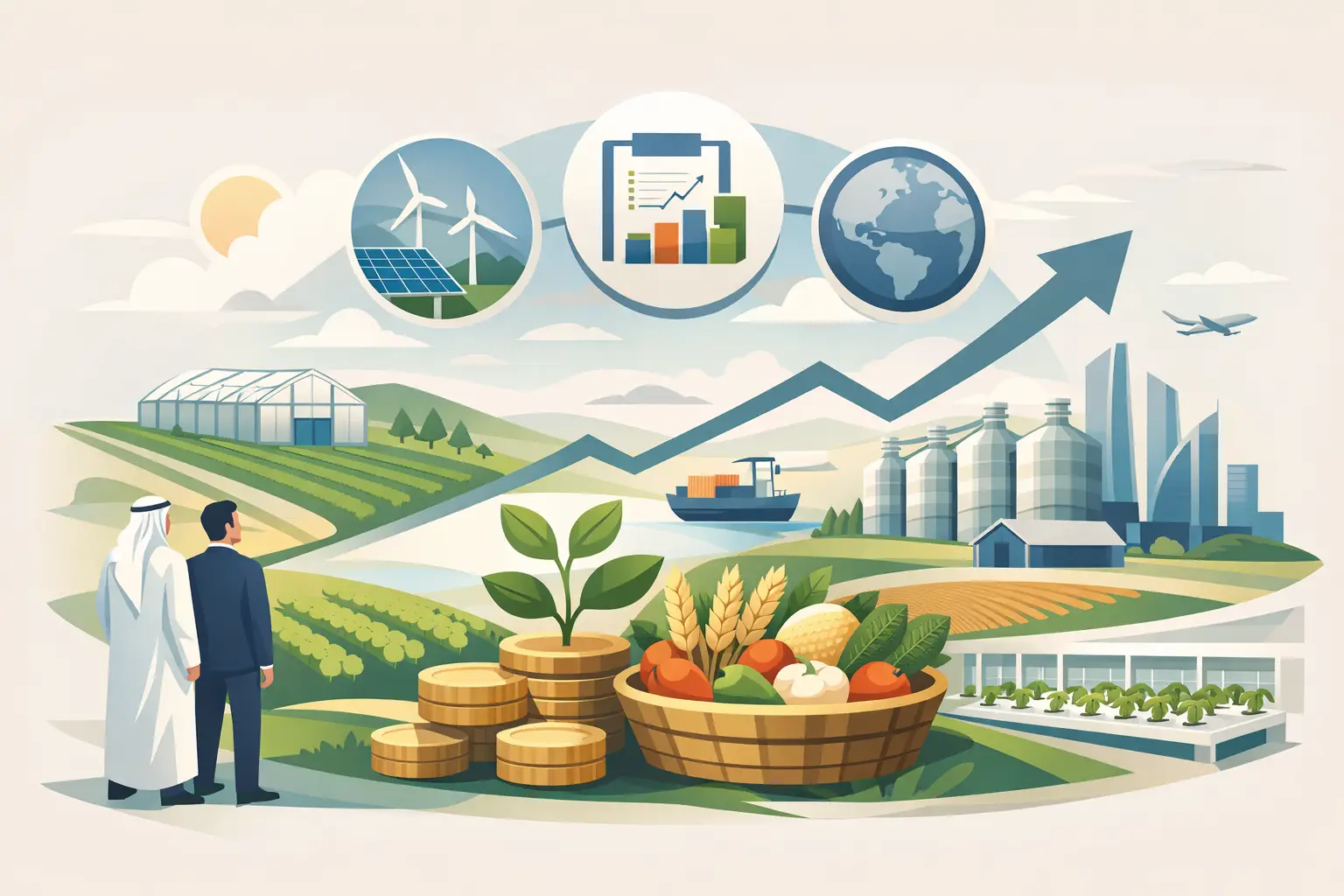
Investing in food security as a strategic option for the future
When supply costs rise or supply chains are disrupted, food security ceases to be a purely operational issue within the agricultural sector and becomes a matter of sovereignty, economics, and investment. Therefore, investment in food security is no longer viewed solely as defensive spending to secure basic needs, but rather as a path to building long-term value, strengthening national resilience, and improving the efficiency of systems related to production, transportation, storage, and processing.
For investors, policymakers, and large corporations, the significance of this initiative lies in its combination of economic returns and developmental impact. It is linked to social stability, improved resource efficiency, reduced waste, and increased self-sufficiency in essential goods, or securing them through reliable partnerships. Furthermore, it opens doors to related sectors, including logistics, energy, agricultural technologies, data solutions, and industrial infrastructure.
Why has investing in food security become a priority?
The shift here is not theoretical. Global food markets have become more sensitive to climate shocks, energy price volatility, logistical bottlenecks, and rising financing costs. In turn, there is a growing need for more resilient food systems that can anticipate risks and mitigate their impact before they escalate into crises.
In economies striving for diversification and sustainable growth, this type of investment gains added importance. It goes beyond simply increasing agricultural production; it encompasses building an integrated system that begins with agricultural inputs and ends with the delivery of the product to the consumer, ensuring consistent quality and more manageable costs. This places food security closely aligned with concepts of industrial sovereignty, urban planning, water management, and technology localization.
In the Saudi context, this vision is reinforced by long-term development goals, where food security is directly linked to the efficiency of supply chains, improved resource utilization, the encouragement of innovation, and increased contribution from value-added productive sectors. Therefore, the discussion surrounding food security must shift from questions of quantity alone to questions of quality, sustainability, and resilience.
What does investing in food security include?
A common misconception is that this sector is limited to land ownership or direct financing of agricultural production. In reality, the value chain is much broader, and its investment opportunities are far more diverse. These include investments in protected agriculture, water management and smart irrigation, biotechnology, cold storage facilities, food processing, specialized transportation, packaging, and data analytics that help predict demand and reduce waste.
The appeal increases when investment is based on sectoral integration. A highly productive agricultural project may lose much of its viability if it is not supported by an efficient logistics infrastructure, adequate storage capacity, or stable distribution agreements. Conversely, investments in food infrastructure may have a greater impact than investments in production alone, especially in environments that require improved post-harvest efficiency and reduced waste.
This integrated understanding is what distinguishes the strategic investor from the investor who views the sector in a fragmented way. Value is not built only on the farm, but on the entire system.
Between financial return and strategic value
This sector doesn't need emotional rhetoric to prove its importance. Its strength lies in serving two purposes simultaneously. The first is economic, creating sustainable business opportunities in sectors that address basic demand. The second is strategic, strengthening the ability of countries and companies to manage food-related risks.
However, this duality does not mean that every project in this field is automatically successful. Returns vary depending on the type of asset, the degree of integration, the regulatory environment, operating costs, the extent of the project's reliance on technology, and the size of the target demand. Some opportunities require a longer time horizon, and some realize greater value when combined with supply contracts, industrial partnerships, or advanced logistical support.
This is where the need for a realistic assessment arises. Investing in food security is not necessarily a quick-profit sector, but it can be one of the sectors most capable of generating compound value when managed with a rigorous operational methodology and a long-term vision.
Where do the highest-value opportunities lie?
The most attractive opportunities are often not the most obvious. Many investors go directly to agricultural production, while the greatest value may lie in the supporting infrastructure that enhances the efficiency of the entire supply chain. Refrigerated storage facilities, for example, play a crucial role in reducing losses and improving price stability. Food processing adds significant economic margin by transforming raw materials into higher-value, longer-lasting products.
Agricultural technologies also open up vast areas for growth. The use of data, sensing, automation, and precision agriculture is no longer a technological luxury, but a direct tool for improving productivity and reducing water, energy, and input consumption. In environments facing climatic or water challenges, these technologies become part of the investment logic itself, not just a subsequent operational improvement.
There are also opportunities arising from the link between food and other sectors. Energy affectsOperating costsLogistics determines distribution efficiency. Digital transformation enhances predictability and control. Even...CybersecurityIt plays an increasingly important role as smart systems expand into agriculture, storage, and distribution. For this reason, multi-sector organizations typically succeed when they view food security as an interconnected system, not an isolated sector.
Challenges that must be clearly understood
Professional discussions about opportunities must be accompanied by frank discussions about challenges. The first of these challenges is the high capital costs in some projects, especially those relying on advanced infrastructure or highly efficient technologies. Water, energy, labor, and cold chain management also pose direct pressures on operational viability.
The second challenge is the sector's sensitivity to external changes. Global prices, shipping costs, raw material availability, and climatic conditions all influence outcomes. This doesn't mean avoiding the sector, but rather that investment design should be based on multiple scenarios, not just the best-case scenario.
The third challenge relates to implementation. Many projects look strong on paper, but struggle with day-to-day operations, market access, or maintaining consistent quality. Therefore, quality management, operational discipline, and the ability to build reliable partnerships are just as important as funding itself.
How can a more mature investment decision be made?
A good decision starts with a clear definition of the objective. Is the goal to boost local supply? To develop a food-related industrial asset? Or to enter a value chain with growing demand? The answer determines the type of project, the financing structure, the performance indicators, and the evaluation period.
Next comes a realistic assessment of resources and constraints. In some cases, priority is given to highly water-efficient projects. In others, investments in storage, distribution, and processing are preferred because they are more suited to the operating environment. There is no one-size-fits-all formula, which makes sectoral and geographical allocation crucial.
Building strong institutional partnerships also significantly increases the chances of success. A technology partner, an experienced operator, logistics providers, and funding agencies all influence the quality of execution. This underscores the importance of investment models that combine capital with operational expertise, rather than relying solely on funding.
In this context, the role of diversified investment groups becomes particularly important when they have the ability to link agriculture, logistics, infrastructure, and technology. This type of integration allows for a deeper understanding of opportunities and enhances the ability to transform separate assets into more efficient and higher-value systems.
Investing in food security within a broader economic vision
When managed strategically, this issue transcends mere food security, contributing to broader economic development. It supports knowledge localization, stimulates industrial innovation, creates quality jobs, and encourages the development of more sustainable business models. Furthermore, it enhances the attractiveness of economies striving to build reliable and resilient supply chains in a rapidly changing global environment.
For this reason, investment in food security must be understood as part of an integrated economic framework, not as a separate item in sectoral policy. True value emerges when operational efficiency meets sustainability, when national vision is coupled with implementation capacity, and when food is treated as a fundamental element of both stability and growth.
The opportunities in this sector are real, but they reward those who analyze them thoroughly, invest patiently, and build them on solid operational foundations. In a world where supply and resources are increasingly sensitive, the wisest bet remains on systems capable of surviving under pressure, not on projects that only look good in ideal circumstances.