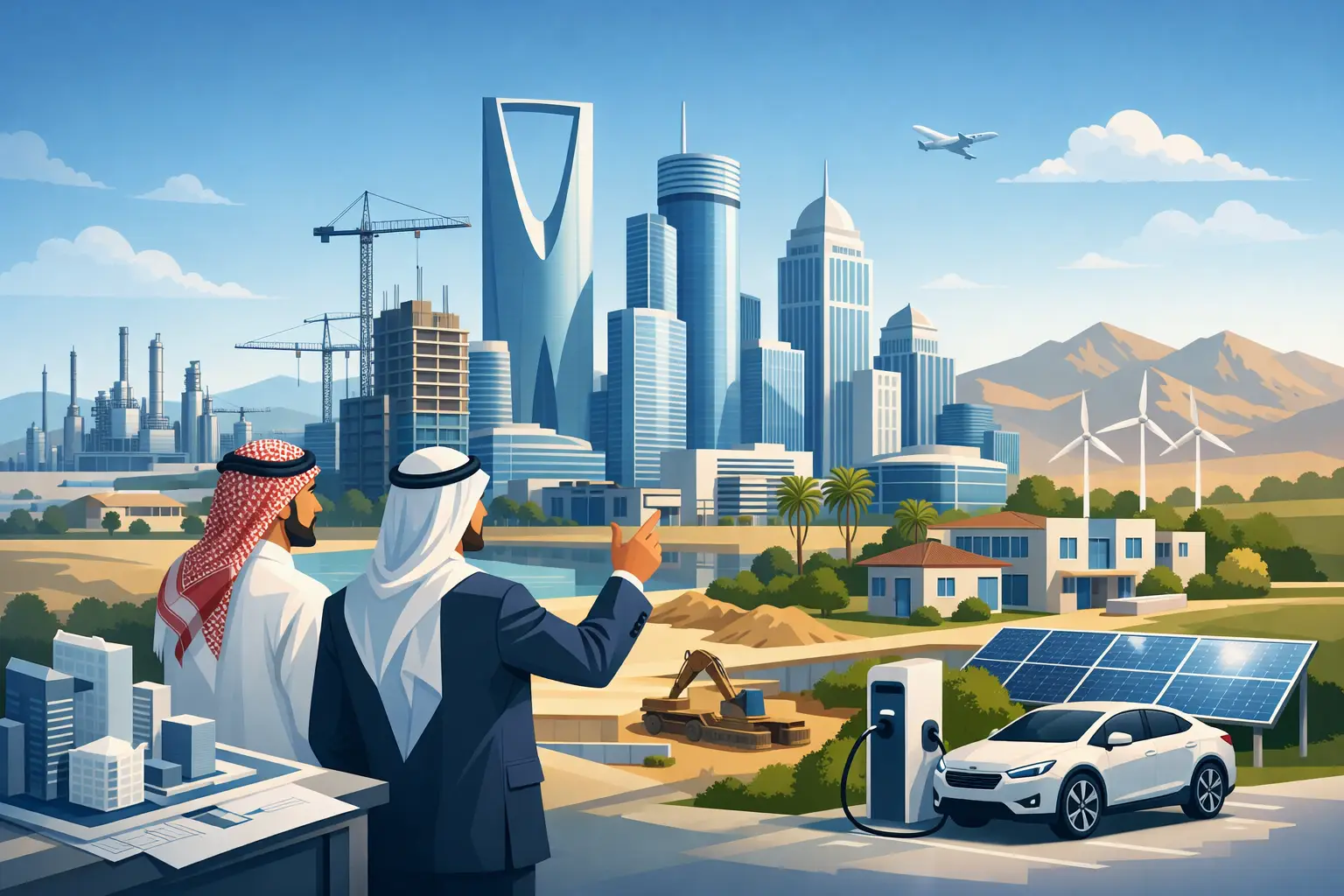
Real estate development in Saudi Arabia: opportunities and modern standards
When measuring urban growth today, the question is no longer how many projects have been launched, but rather what economic and urban value they will add after ten years. It is precisely here that discussing real estate development in Saudi Arabia becomes a discussion of a long-term national infrastructure, not a short-term construction cycle or a temporary surge in demand.
Why has real estate development in Saudi Arabia become a strategic focus?
The Saudi real estate market can no longer be understood through the traditional lens that links development solely to increased supply. What is happening today is a reshaping of housing, work, transportation, and service patterns within an economic environment where the contribution of non-oil sectors is expanding, and where cities are emerging as engines of production, investment, and quality of life simultaneously.
This transformation is driven by several interconnected factors. First, population growth, changing demographics, and rising expectations among end-users—whether families seeking complete housing, companies needing efficient operational assets, or institutional investors evaluating returns based on sustainability and the asset's growth potential—are key drivers. Second, Saudi Vision 2030 has raised expectations beyond mere urban expansion to the development of communities, business centers, and specialized destinations that serve the national economy in multiple dimensions.
In this context, a successful developer is one who understands the relationship between urban planning, finance, supply chains, organization, and technology, not simply one who manages a good construction project. The difference today lies in integration.
New features of the Saudi real estate market
The most notable feature of the current phase is that demand has become more selective. In the residential sector, location alone is no longer sufficient. There is a growing focus on the quality of planning, the efficiency of spaces, support services, accessibility, and operational efficiency after handover. In the commercial sector, the appeal of some traditional, inflexible assets has declined, while interest has increased in mixed-use projects, offices that meet the needs of modern businesses, and facilities related to the digital economy and logistics.
Furthermore, the diversity of cities and regions necessitates a more nuanced analysis. Not every high demand translates into an immediate opportunity, and not every developable plot of land guarantees investment viability. Some markets are well-suited to mid-range residential development, while others require hospitality facilities, warehousing, or assets serving specific sectors such as healthcare, education, or e-commerce. Therefore, assessing the local market at the neighborhood level, considering purchasing power and usage patterns, has become more crucial than relying solely on general indicators.
Real estate development in Saudi Arabia: between opportunity and discipline
The opportunities are vast, but the market doesn't reward unchecked expansion. Many promising projects falter not because of weak demand, but because of poor timing, inflated costs, or a mismatch between the product and the target market. This is why organizational discipline is a crucial component of any successful development strategy.
Discipline here begins with a realistic, not merely optimistic, feasibility study. It includes building a balanced financing structure, meticulous cash management, clear execution contracts, and governance that ensures risk monitoring from the outset. It also requires a constantly updated regulatory outlook, as the real estate environment in the Kingdom is witnessing continuous developments in standards, procedures, and requirements—a positive development that necessitates greater efficiency in compliance and implementation.
A developer who approaches these factors with an institutional investment mindset is better equipped to protect long-term value. Those who focus on rapid launch without a solid foundation may achieve temporary success but will later face operational and marketing challenges.
Where are the most mature opportunities concentrated?
The residential sector will remain a key driver of the market, but its opportunities are not uniform. There is a clear demand for products that strike a balance between price and quality and are genuinely relevant to the needs of Saudi families. Projects that succeed in this sector are often those that understand everyday living patterns and offer practical solutions in design, amenities, and flexibility, rather than relying on superficial appearances or excessively large spaces.
Conversely, it stands outHospitality sectorIntegrated destinations, as a growth area, are linked to increased tourism, business, and events. This type of development requires an operational vision from the outset, because the success of an asset depends not only on its construction but also on its ability to attract visitors and deliver a consistent experience and sustainable operating return.
As forLogistics and industrial sectorThis is one of the most strategically important sectors. The expansion of trade, improved infrastructure, and the increasing importance of supply chains have all driven up the value of assets related to warehousing, distribution, and light manufacturing. This highlights the advantage of a developer who understands the actual operational requirements of tenants, not just general property specifications.
Mixed-use developments are also increasingly attractive in select locations because they reduce reliance on a single revenue stream and offer the asset greater flexibility to adapt to market demands. However, this model is not suitable for every location. Its success depends on population density, accessibility, the nature of local demand, and the quality of post-operation management.
Sustainability is no longer just a cosmetic element.
Previously, sustainability was sometimes viewed as a marketing gimmick. Today, it has become a factor that directly impacts operational efficiency, asset attractiveness, and tenant and user retention. Buildings that are more energy and water efficient, and better managed in terms of assets and services, have a clear advantage in the medium and long term.
This doesn't mean that every project needs the highest technical specifications regardless of its viability. It depends on the type of asset, its location, its target user base, and the total lifecycle cost. However, it's certain that ignoring sustainability standards increases operating costs and weakens a project's future competitiveness. Therefore, the early integration of smart design, appropriate materials, and operational technologies has become an economic decision before it is an environmental one.
The role of technology in increasing the value of real estate assets
Technology has transformed how we plan, execute, and manage. Using data for demand analysis, digital modeling in design, and smart building management solutions are all tools that enhance decision-making accuracy, reduce waste, and improve user experience. But the value of technology isn't simply its existence; it's its application in truly impactful ways.
For example, building management systems may have a significant impact on commercial and hospitality assets, while in some residential projects, the priority is maintenance efficiency, community management, and ease of access to digital services for residents. In other words, successful technology is that which serves the operating model and expected return, not that which is used as a general label of modernity.
From an investment perspective, assets managed with clearer data and stronger operational governance are better positioned to attract partnerships and institutional funding. This aligns with the approach of business groups that focus on integrating development, construction, and digital transformation, as this provides a more comprehensive view of value management across the entire project lifecycle.
What distinguishes a developer who is able to persevere?
Sustaining a presence in the Saudi market isn't solely about owning land or executing a single successful project. What distinguishes a developer capable of building a sustainable track record is their ability to replicate success within clear institutional frameworks. This includes quality site selection, pricing discipline, efficient contractor management, sound governance, and the ability to deliver on time and to the expected quality.
Likewise, specialized partnerships are becoming increasingly important. Some projects require a strong operational partner, while others need deep technical, engineering, or financial expertise. It is not always wise for the developer to keep all roles internal. Sometimes, the best outcomes are achieved by building carefully chosen alliances that enhance execution quality and distribute risk.
This is where the leadership aspect comes in. BecauseReal estate development in Saudi ArabiaIt is no longer a sector separate from others, but rather a meeting point between infrastructure, services, energy, mobility, hospitality, and the digital economy. The broader the vision, the greater the ability to develop assets more closely aligned with real market needs.
What should be monitored in the coming years?
The most important indicator is not just the volume of new launches, but the quality of absorption and operational sustainability. Healthy markets are those that achieve a balance between supply and demand, maintain an acceptable level of occupancy, and produce assets capable of serving the local economy, not just adding numbers to the overall picture.
Competition will also increasingly focus on efficiency, quality, and operational excellence. Similar projects will face greater pressure, while those offering clear and sustainable value will gain more trust from investors, users, and partners. Developers who combine local expertise with global standards in execution and management are also likely to gain prominence.
For investors and partners, a thorough understanding of the Saudi market today requires distinguishing between genuine growth and superficial growth. The opportunity is there, but it hinges on choosing the right sector, timing, partner, and operating model. This is a market that rewards long-term vision and institutional strength, not just quick decisions.
Ultimately, the value of any real estate project is not measured at the laying of the foundation stone, but rather when, years later, it proves to be a productive, operational asset that meets the needs of the city and the economy. This is the trend that will define the future of real estate development in Saudi Arabia in the coming phase.