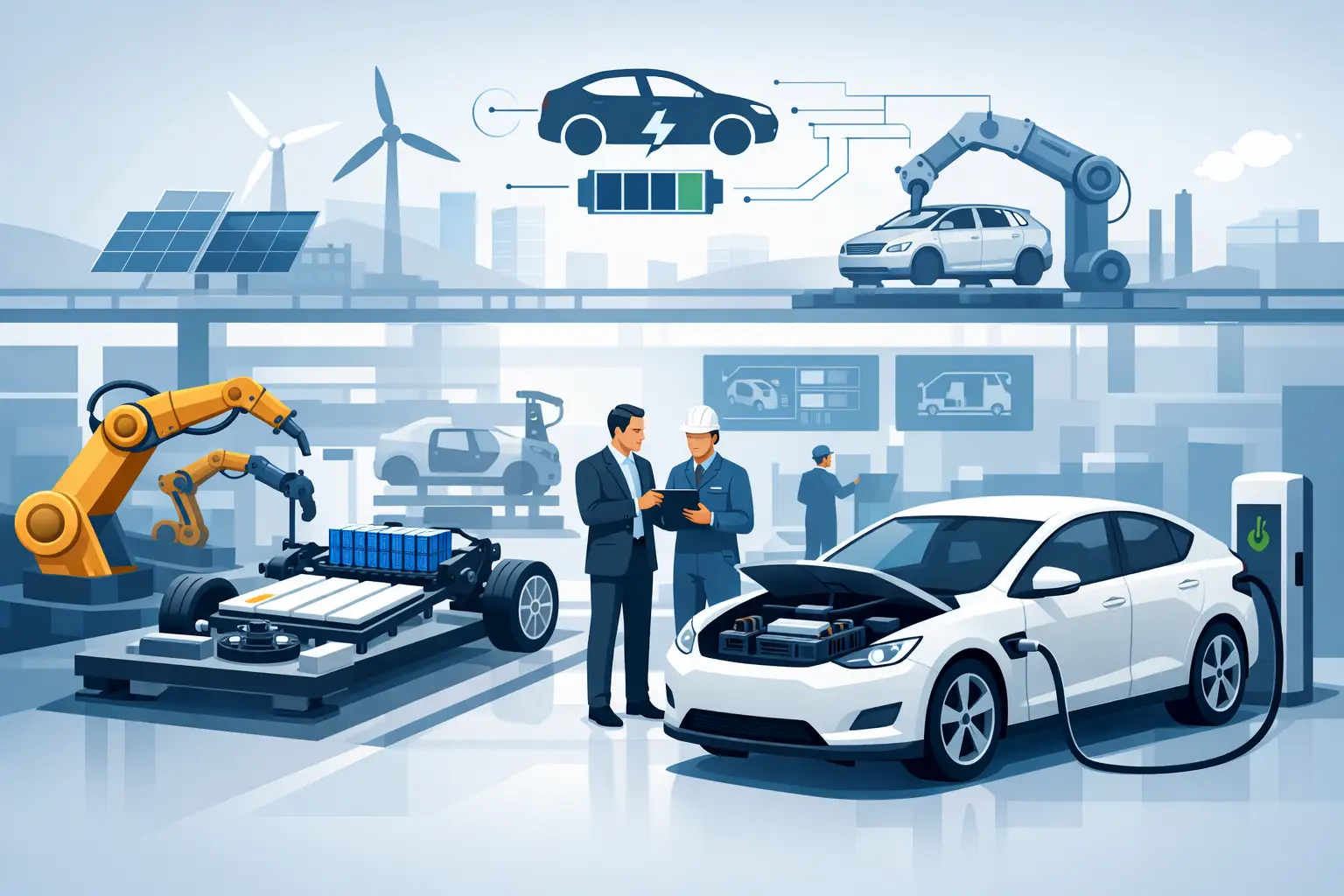
Stages of electric car manufacturing, from design to production
When one looks atelectric carAs a sleek, quiet, and highly efficient end product, it might seem easy to reduce it to just the battery and motor. But the manufacturing process of electric vehicles is far more complex, combining mechanical engineering, advanced electronics, intricate supply chains, rigorous quality control systems, and industrial sustainability requirements all at once. From an investment and industry perspective, understanding this process not only clarifies how the vehicle is made but also explains where value is generated, where risks arise, and how to build a competitive manufacturing capacity in the long term.
What makes the manufacturing process of electric cars unique?
The fundamental difference between an electric car and a conventional car is not simply the absence of an internal combustion engine. The product's architecture itself is changing. In an electric vehicle, the battery becomes a central component in terms of design, cost, safety, and performance, while software, power management, electronic control units, and component integration become increasingly important.
This means the factory is not just dealing with interconnected mechanical parts, but with an integrated technological system that demands higher precision in assembly, testing, and calibration. Furthermore, any flaw in heat management, high-voltage insulation, or control system programming can directly impact reliability, safety, and user experience.
From engineering concept to manufacturable design
The process begins long before the production lines. The first stage is defining the platform specifications—driving range, battery capacity, vehicle class, target weight, performance, safety requirements, and expected usage model. These decisions are not theoretical, as they affect everything that follows, from chassis size to cell type to cooling system architecture.
Next, the engineering teams move on to designing the platform, chassis, electrical system, and software. Here, a delicate industrial equation comes into play: every performance improvement may increase cost, every weight reduction may increase manufacturing complexity, and every range extension may strain the battery supply chain. Therefore, a successful vehicle is not built on the best single component, but rather on the optimal balance between performance, cost, and manufacturability.
At this stage, digital modeling and simulation are also used to test impact, heat management, power consumption, structural rigidity, and electronic system compatibility. The goal is not just to achieve a functional product, but a product that can be manufactured efficiently and on a large scale.
Manufacturing the structure and basic components
The physical aspect often begins with the fabrication of the body. Sheets of metal or composite materials are formed and then assembled using welding or other industrial bonding techniques. Since the battery is often integrated into the vehicle floor, the body design must achieve high rigidity with balanced weight distribution and robust protection in the event of a collision.
Following the chassis come key components such as the suspension, axles, steering units, braking systems, and interior. Some of these parts are similar to those used in conventional cars, but the differences lie in their integration with a relatively heavier electrical system that is more sensitive to thermal and weight distribution.
Electric vehicles also require insulation materials, wiring harnesses, and high-voltage connections that differ in their specifications and standards from conventional cars. This adds another layer of specialization to the manufacturing and assembly lines.
The battery is at the heart of the electric vehicle manufacturing process.
Cell manufacturing and package assembly
The battery is the most sensitive component in terms of both technical value and cost. The process begins with cell manufacturing, an advanced stage involving material chemistry, coating, drying, stacking or winding, followed by packaging, sealing, and testing. These processes require highly controlled production environments, as even slight variations in quality can affect performance, lifespan, or safety.
After the cells are manufactured, they are assembled into modules, and then into a complete battery pack. The pack does not simply mean arranging the cells inside a metal casing, but also includes the battery management system, sensors, power connections, cooling or heating systems, mechanical protection, and electrical insulation.
Cooling, safety and quality
One of the most significant challenges is thermal management. A battery that performs exceptionally well under laboratory conditions may experience a decline in efficiency or accelerate its degradation if the cooling system is not properly designed. Therefore, vehicle efficiency, charging speed, and lifespan are directly linked to the efficiency of the battery's thermal design.
Safety here is not a separate item, but a standard that accompanies every step. The packages are tested against vibration, shock, humidity, varying temperatures, and extreme loading and unloading conditions. As production volumes increase, the importance of tracking and quality systems grows, because detecting defects after delivery is far more costly than preventing them within the factory.
The electric motor and powerful electronics
An electric motor is mechanically simpler than a combustion engine, but it relies on highly precise materials, magnets, and electronic controls. The stator and rotor are manufactured separately, and then the motor is assembled with a power inverter, reduction unit, and control system, depending on the vehicle's design.
Power electronics are of particular importance because they manage the energy transfer between the battery and the motor, affecting efficiency, responsiveness, and operating temperature. Internal charging units, transformers, and power distribution systems are also added to serve the various circuits within the vehicle. At this stage, the quality of programming and calibration becomes just as important as the quality of the component itself.
Software is no longer a secondary layer
In modern electric vehicles, software is an integral part of the product, not an aftermarket addition. Battery management systems, traction control, energy recuperation during braking, charge management, and self-diagnosis all rely on sophisticated and constantly evolving software.
This changes the logic of manufacturing. The goal is no longer simply to produce a vehicle that leaves the factory in good working order, but rather a platform that can be upgraded and improved throughout its operational life. However, this approach adds challenges in...CybersecuritySoftware verification and version compatibility management are issues of increasing importance in any advanced manufacturing software.
Final assembly and testing
How do all the systems meet in a single line?
In the final assembly stage, the chassis is integrated with the battery, drive unit, wiring, cabin, electronics, wheels, and interior panels. This stage appears straightforward on the surface, but it relies on extremely precise coordination between multiple suppliers and interconnected sub-lines.
Any delay in a single component can affect the entire production line. Therefore, supply chain management, scheduling, inventory tracking, and supplier capabilities are as critical as the engineering itself. In the electric vehicle manufacturing environment, this sensitivity is amplified by the heavy reliance on electronic components and battery materials.
After assembly, the vehicle undergoes mechanical, electrical, and software testing. High-voltage insulation, inter-unit connectivity, charging efficiency, drive system calibration, and detection of abnormal noise or vibrations are all checked. Road tests and final quality tests are also conducted before delivery.
Cost, expansion, and the industrial value chain
One of the biggest challenges in the electric vehicle manufacturing process is finding a balance between quality, price, and scale. In the early stages of any industrial project, costs are high due to low production volumes, high component prices, research and development costs, and infrastructure investment. As production increases, economies of scale improve, but this requires stable demand, reliable suppliers, and a highly disciplined operating system.
Industrial localization also plays a strategic role in this equation. The higher the percentage of components manufactured locally, the better the quality control and lead times, the lower some supply risks, and the greater the added value to the national economy. However, localization is not achieved by a single decision, but rather through building a system that includes materials, engineering, testing, technical personnel, and technological partnerships.
In this context, developing industrial capabilities in electric vehicles aligns with broader trends related to sustainability, economic diversification, and building advanced manufacturing sectors that support the Kingdom's long-term growth objectives. This makes the issue not only industrial but also developmental.
Why does success depend on the system and not just the factory?
It is a mistake to view electric vehicle manufacturing as merely an assembly project. True success depends on an integrated system that includes charging infrastructure, regulatory standards, raw material availability, testing capabilities, skilled workforce training, maintenance networks, and the ability to develop and update software.
For this reason, an investor or industrial partner evaluating this sector needs a broader perspective than just product lines. The most important question is: Is there an operational and technological foundation capable of sustainably expanding and improving over time? Because an electric vehicle is not a static product, but rather an industrial and technological platform that is constantly evolving.
This understanding has become increasingly prominent among industry groups with a long-term perspective, including entities that view electrical manufacturing as part of a broader system.Energy includesLogistics, digital transformation, and the development of industrial value chains.
Ultimately, the electric vehicle manufacturing process reveals a clear truth: competitiveness isn't built solely within the factory, but also in the quality of the decisions made there and the institutional capabilities that surround it. Any entity seeking a significant position in this sector needs to combine industrial discipline, technological flexibility, and a long-term vision—because true value emerges when technology translates into reliable and scalable production capacity.