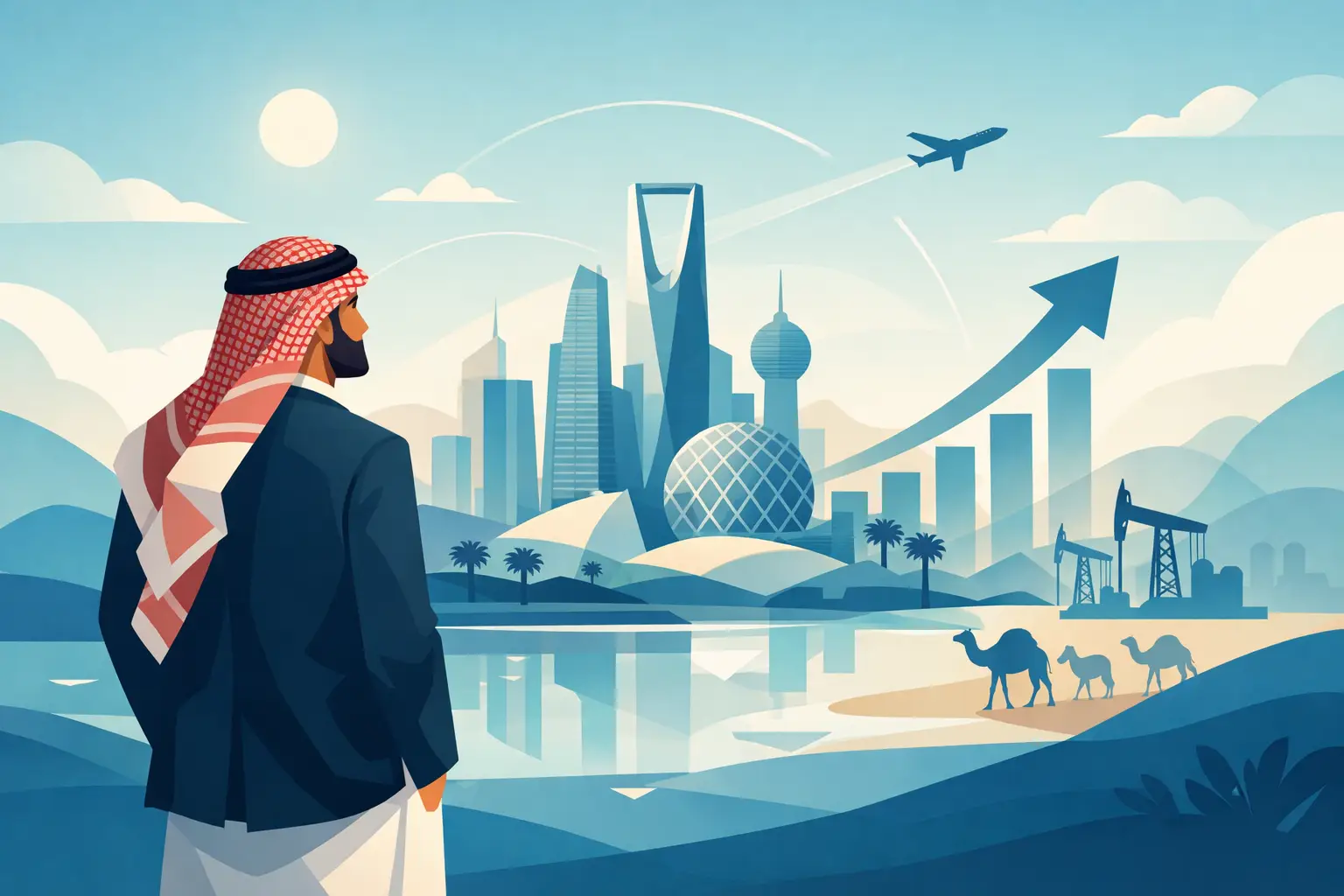
The Saudi CEO and his role in achieving the goals of Vision 2030
When measuring the impact of leadership in the Kingdom today, it is not solely based on the number of companies, but rather on the leader's ability to transform capital into national value. This is where the meaning of a Saudi CEO in Vision 2030 emerges – not merely as an administrative role, but as a strategic one that combines economic growth, governance, building competitive sectors, and fostering trust among investors, partners, and decision-makers.
Vision 2030 has not only raised the bar for ambition but has also redefined executive success. It is no longer enough for a CEO to manage stable operations or achieve short-term financial growth. The standard today is broader and more precise: Does he develop sectors of national priority? Does he create quality opportunities? Does he balance expansion with discipline? And does he translate Saudi ambition into institutions capable of surviving through economic cycles and market changes?
What does it mean to have a Saudi CEO in Vision 2030?
This question is less about nationality and more about alignment with a comprehensive national project. The ideal Saudi CEO, in this context, is one who understands that the Saudi economy no longer operates on the logic of relying on a single sector or a traditional growth model. What's needed is leadership that embraces diversification, considers value chains, and manages expansion based on good governance, not impulsiveness.
In both emerging and established sectors, there is a growing need for a leader who sees the interconnectedness of industry, energy, technology, services, hospitality, and real estate.CybersecurityAnd food. This interconnected perspective is not an intellectual luxury. It is a real prerequisite for being able to build business groups that operate within a rapidly reshaping economy, and which gives an advantage to those who read the shifts early.
A CEO aligned with Vision 2030 doesn't simply monitor quarterly financial indicators; they also consider asset quality, capital allocation efficiency, the growth potential of local talent within the organization, and the company's readiness to operate under higher regulatory and investment standards. This is what distinguishes serious executive leadership from management that merely observes the external aspects.
Executive leadership between national ambition and institutional discipline
One of the biggest challenges facing any Saudi CEO in Vision 2030 is combining speed with discipline. The Saudi environment today is brimming with opportunities, but this abundance might tempt some organizations to expand before their operational infrastructure is complete or their governance model is mature. This is where the value of leadership—knowing when to move forward and when to reassess priorities—becomes crucial.
Investing in promising sectors such as advanced manufacturing, energy, mobility, and technology.PropertyIt doesn't succeed with rhetoric alone. It needs a CEO who can determine whether the company has a genuine competitive advantage or just a nominal presence. It also needs the ability to differentiate between real growth and growth that looks good on paper but drains cash, increases complexity, and dilutes focus.
For this reason, governance has become an integral part of the leadership picture, not a separate legal element. Investors, government entities, and international partners all now examine how decisions are made within an organization. Who approves? Who reviews? How are risks distributed? How are conflicting interests managed? And how is transparency built internally before being presented externally?
A strong CEO doesn't shy away from these questions. On the contrary, they use them as a source of trust. And the larger and more diverse the organization, the more important this approach becomes.
From managing companies to building systems
The most significant shift in the Saudi market is that leadership is no longer confined to operating a single company within a single sector. Many opportunities today arise at the intersection of sectors. A real estate project requires a technological infrastructure. Industrial expansion requires disciplined financing and a reliable supply chain.HospitalityIt is linked to tourism, identity, and services. Food security is no longer just an agricultural issue, but also an investment, sustainability, and logistics issue.
This is where the demand rises for a CEO who thinks in terms of systems. This mindset means that value is not generated solely from a single asset, but from the group's ability to coordinate assets, expertise, and resources within a clear strategic direction. However, it also carries a well-known risk: diversification, if lacking discipline, can turn into fragmentation. Therefore, the issue is not simply expanding the number of sectors, but rather identifying where true integration lies and where the managerial burden begins.
In this context, the importance of leadership that can move confidently both locally and internationally with awareness becomes clear. Expanding outside the Kingdom offers Saudi companies opportunities to access new markets, diverse expertise, and broader networks, but it is not an automatic achievement. If not based on a sound legal, operational, and financial understanding, it can consume management rather than enhance it. A mature CEO knows that international expansion is not a mere display of strength, but rather a carefully considered tool for reinforcing the company's strategic position.
Capital alone is not enough
In a rapidly changing environment, capital is no longer the sole factor in shaping economic influence. Corporate reputation, the ability to attract partners, effective governance, and quality of execution have all become assets as valuable as finance. Therefore, a CEO's image is no longer solely tied to major deals or high-profile statements, but rather to their ability to cultivate long-term trust.
Trust here is not a general concept. It is a direct result of clear management behavior: respect for commitments, a transparent structure, professional negotiation, realistic promises, and a willingness to be held accountable. At this level, executive leadership becomes part of a respected economic structure, not just a media facade.
This is what makes certain names stand out so prominently, as their presence is linked to a coherent discourse centered on value, reach, and discipline. When this is coupled with a clear Saudi identity and an awareness of the national transformation, their standing is further strengthened. This pattern has emerged in leadership models that build their presence on well-considered expansion, good governance, and the ability to operate across multiple sectors, as exemplified by Hamdan Awadhi Al-Anzi's experience within a business framework focused on long-term growth and international expansion.
The cultural dimension in the image of the Saudi CEO
In the Kingdom, economic leadership is not understood in isolation from its social and cultural context. This does not mean prioritizing affiliation over competence, but rather that roots, identity, and family name can add a dimension of credibility and public recognition, especially when coupled with a disciplined professional track record. Many successful Saudi leaders understand that market legitimacy is built not only on numbers, but also on consistency between public image and actual practice.
In this respect, the Saudi CEO bears an additional responsibility. He represents not only an institution but also a model of what national leadership can be during a period of economic restructuring. Therefore, the language he uses, the values he proclaims, and his public persona become elements with an impact that extends far beyond the company itself.
However, this cultural dimension can become a burden if used as a substitute for performance. The Saudi market today is more mature, stakeholders are more discerning, and international partners are more detail-oriented. Therefore, symbolism alone is insufficient. Ultimately, what matters is the quality of the decision, the soundness of the structure, and the organization's ability to deliver on its promises.
Where is the value of the CEO headed in the coming years?
Future value will not belong to those who talk a lot about transformation, but to those who build organizations capable of thriving within it. This means that the CEO of the next phase will be measured by their ability to achieve four things simultaneously: business growth, reputation protection, talent development, and risk management without undue delay.
Pressure will also increase on leaders working in economically or organizationally sensitive sectors. The more an activity is linked to energy, industry, real estate, security, technology, or transportation, the greater the need for astute leadership that knows how to seize major opportunities without falling into the trap of uncontrolled expansion.
Conversely, those who succeed in this equation will gain a significant advantage. The Kingdom is not simply looking for companies that grow, but for institutions that elevate the quality of the economy itself. A CEO who understands this will not position themselves outside or on the margins of Vision 2030, but will instead make their daily decisions an integral part of its practical implementation.
Therefore, discussing a Saudi CEO within the framework of Vision 2030 is not merely about a position, but about a level of responsibility. It is a role that demands calculated ambition, an institutional presence, and the ability to transform opportunities into a structured economic impact. The more noisy the market becomes, the greater the value of a leader who speaks the language of results, operates with a nation-state mindset, and builds enough trust to ensure their influence endures beyond each growth cycle.