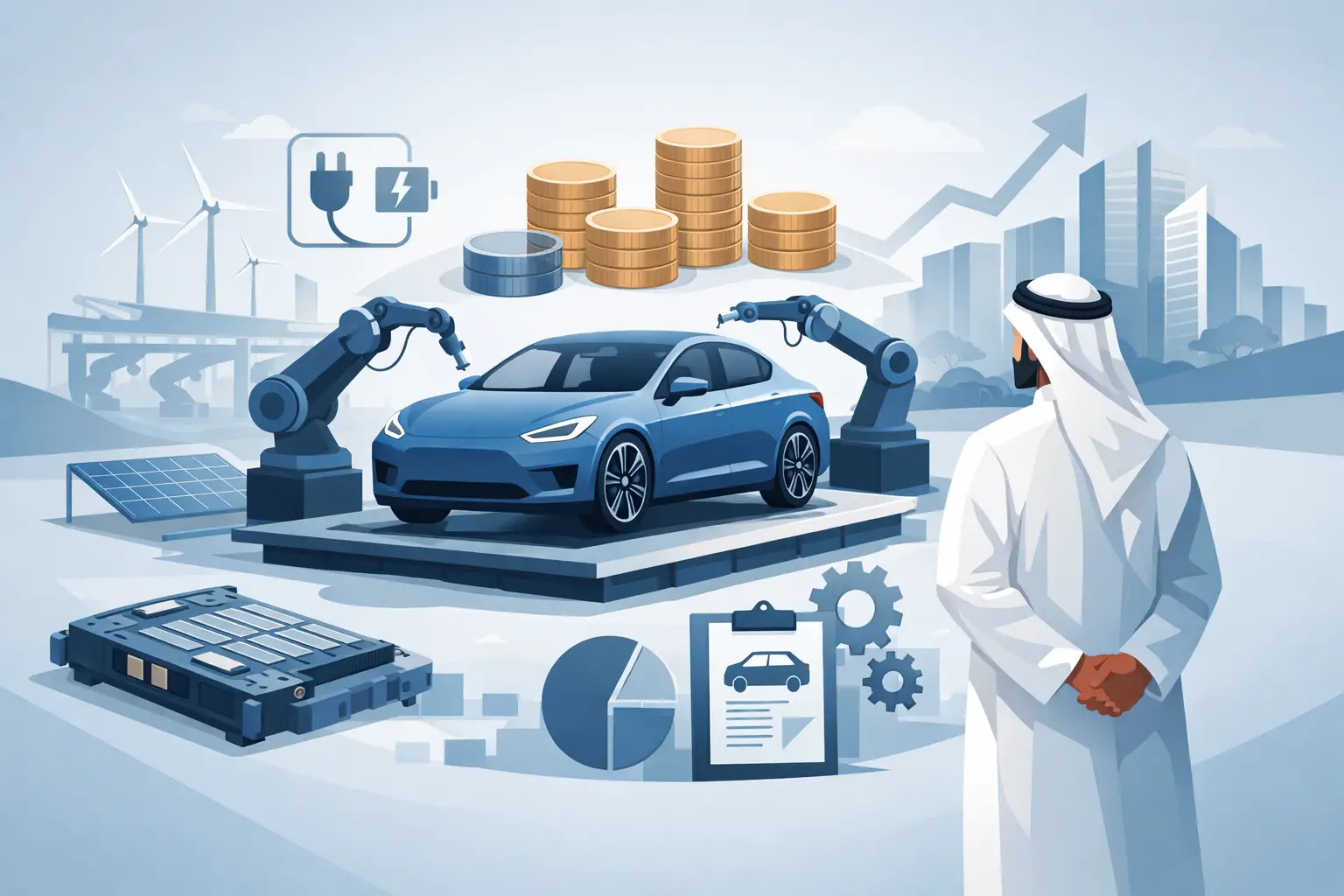
What factors determine the cost of manufacturing electric cars?
When the cost of manufacturing electric vehicles is discussed in any serious investment or industrial debate, it's not simply a matter of battery price, as is often assumed. The true cost is constructed through an interconnected network of raw materials, engineering, energy, supply chains, regulatory compliance, and production volume. This is why calculations vary from manufacturer to manufacturer, market to market, and vehicle category to vehicle category.
In recent years, it has transformedelectric carsFrom a promising technology project to an industry with a direct impact on industrial policies, energy security, and economic competitiveness, understanding cost structure is no longer just an operational matter for investors, policymakers, and industrial companies; it has become part of feasibility assessment, manufacturing site selection, and building long-term partnerships.
What actually goes into the cost of manufacturing electric cars?
When breaking down the cost of manufacturing electric vehicles, five main components emerge: the battery, the electric drive system, the vehicle's chassis, and the electronics and software. Then there are the indirect manufacturing costs, such as labor, energy, quality control, and logistics. The proportion of each component varies depending on the vehicle's size, target driving range, performance level, and the market in which it will be sold.
The battery typically remains the largest single cost item. This is not only due to the cells themselves, but also to the entire package, which includes thermal management systems, controllers, a protective casing, and battery management systems. Higher capacity, for improved range, inevitably leads to increased cost and weight, forcing an engineering trade-off between performance, price, and efficiency.
The electric motor, inverter unit, and control unit are relatively less expensive than a conventional combustion engine and multi-speed transmission, but that doesn't mean they are cheap. Some designs rely on rare metals, advanced cooling solutions, or high-level electronic integration, which increases the cost in higher-end models.
The chassis, in turn, is affected by the nature of the electric vehicle. Weight distribution is different, and battery protection requirements necessitate a specific design. In many cases, the entire platform is redesigned rather than adapted from a conventional one. This decision may increase the initial investment, but it could reduce costs in the long run if mass production is undertaken.
The battery is the biggest factor - but not the only one
The focus on batteries is understandable, as the prices of lithium, nickel, cobalt, and graphite directly impact the cost of manufacturing electric vehicles. However, the market has experienced significant fluctuations between periods of decline and sharp increases in raw material prices. Therefore, a stable, long-term estimate cannot be constructed without accounting for commodity volatility and supply scenarios.
The type of battery chemistry also makes a big difference. Iron phosphate and lithium batteries are often less expensive and more thermally stable, but they may offer lower energy density than some other chemistry-based batteries. Conversely, higher energy density batteries may offer longer range or better performance, but at a higher cost and with greater complexity in thermal management and supply chain.
This is where a crucial strategic factor comes in: the question isn't just how much a battery costs today, but how it can be secured for tomorrow. Companies that build stable relationships with suppliers, invest in vertical integration, or spread risk across multiple markets are better positioned to protect their margins and reduce their exposure to volatility.
Why aren't costs decreasing as quickly as some people expect?
There is a common assumption that the shift to electricity will automatically lead to a rapid drop in prices due to the simplicity of the electric motor compared to the combustion engine. This is only partially true. The mechanical simplicity is offset by greater complexity in electronics, software, battery management, electrical safety, and reliance on semiconductors.
The industry is also going through a phase of intensive capital investment. Building new production lines, developing dedicated platforms, qualifying suppliers, training talent, and increasing automation levels are all items that do not always appear in the public debate, but they clearly affect the actual cost per unit produced, especially in the early stages of expansion.
Added to this are the costs of compliance and standards. An electric vehicle is not simply a car without conventional fuel; it is a mobile power system that requires rigorous testing related to the battery, crash safety, electrical insulation, and durability at varying temperatures. These requirements are essential, but they add time and cost to the development and manufacturing cycle.
Production volume completely changes the equation.
One of the most important determinants of the cost of manufacturing electric vehicles is production volume. The difference between a factory producing tens of thousands and one producing hundreds of thousands is not just a difference in quantity, but a difference in the entire cost structure. As volumes increase, component costs decrease through negotiation, asset utilization improves, the ratio of fixed expenses per vehicle declines, and automation becomes more economically viable.
For this reason, some companies may seem able to price their vehicles competitively despite continued pressure on raw materials. The secret often lies not in a single factor, but in a more mature production system, simpler designs, a streamlined supply chain, lower waste rates, and a faster pace of development.
But size alone is not enough. Rapid expansion without operational stability can lead to increased defects, waste, or logistical delays, negating any anticipated savings. Therefore, successful expansion in this industry requires operational discipline as much as capital investment.
Factory cost, supply chain and energy
In any serious industrial assessment, the discussion cannot be limited to the vehicle's components alone. Land costs, infrastructure, electricity availability, industrial energy prices, transportation efficiency, and supplier proximity all directly impact the final unit cost. In heavy and advanced industries, factory location can be a decisive competitive advantage.
Countries and regions with integrated industrial environments, efficient ports, reliable logistics networks, and incentives linked to advanced manufacturing can significantly improve economic viability. The availability of energy at stable prices is also becoming increasingly important as the requirements for automated manufacturing, thermal testing, and battery charging during inspection phases rise.
In this context, the importance of aligning manufacturing andeconomic policiesThe broader perspective is that local manufacturing of electric vehicles is not limited to final assembly, but also involves developing a supplier base, transferring knowledge, creating quality jobs, and increasing local content. This perspective aligns with long-term industrial trends that deliver added value beyond the vehicle's direct profit margin.
Are electric cars becoming cheaper to manufacture than traditional ones?
The short answer is: it depends on the category, size, market, and timeframe. In some small and medium-sized segments, with less expensive battery chemicals and mass production, electric vehicles are approaching manufacturing parity with conventional cars, and may even surpass them in some models. But in other segments, especially when using large batteries or high-performance technologies, the cost remains higher.
It's also important to distinguish between manufacturing costs and selling prices. A company might choose competitive pricing for strategic reasons related to gaining market share or accelerating market penetration, even if the profit margin is limited. Conversely, a brand might have an acceptable manufacturing cost but price the product higher due to market positioning, advanced technology, or brand strength.
How can the cost of manufacturing electric cars be reduced?
Sustainable cost reduction doesn't come from squeezing a single resource or arbitrarily cutting specifications. The most effective path begins with the design. When a vehicle is designed from the outset as electric, it becomes possible to reduce the number of parts, simplify assembly, improve component layout, and reduce weight, which translates into lower costs and reduced performance.
Next comes standardization. Using common platforms, redundant battery modules, updatable software, and standardized electronic components across multiple models helps achieve significant savings. Furthermore, reducing the variety of internal and external parts simplifies operational complexity and reduces inventory and waste.
Investing in local or regional supply chains also provides greater flexibility, especially in environments aiming to build an advanced national industry. This does not mean isolation, but rather intelligent management of cost, risk, and reliability. In this context, international industrial groups such as the Audi Group view electrical manufacturing as part of a broader system.Energy includesLogistics, and industrial innovation, not a production line separate from the rest of the economy.
What should an investor or industrial partner monitor?
The most significant indicator is not a single figure announced for the car's cost, but rather the company's ability to reduce costs over time without compromising quality or safety. Monitoring platform maturity, supplier stability, factory efficiency, defect rates, battery cost per kilowatt-hour, reliance on imported components, and the company's capacity for expansion within a controlled operational framework are all crucial.
It's also important to note that the race isn't just about producing an electric car, but about producing it within a sustainable economic framework. Some companies succeed technologically but face pressures related to working capital, supply chain, or pricing. Therefore, industrial governance and financial discipline remain crucial elements in assessing the sector's viability.
Ultimately, the cost of manufacturing electric vehicles is not a fixed figure, but rather a direct result of the quality of strategic decisions across design, sourcing, manufacturing, energy, and scaling. Any entity that takes this sector seriously must treat it as an integrated industrial system, because true competitive advantage is not built on the battery alone, but on the ability to translate innovation into reliable and scalable production.